BSR Approval Changes for Rooftop Mast Installations: What the New Exemption Means for Telecoms Projects
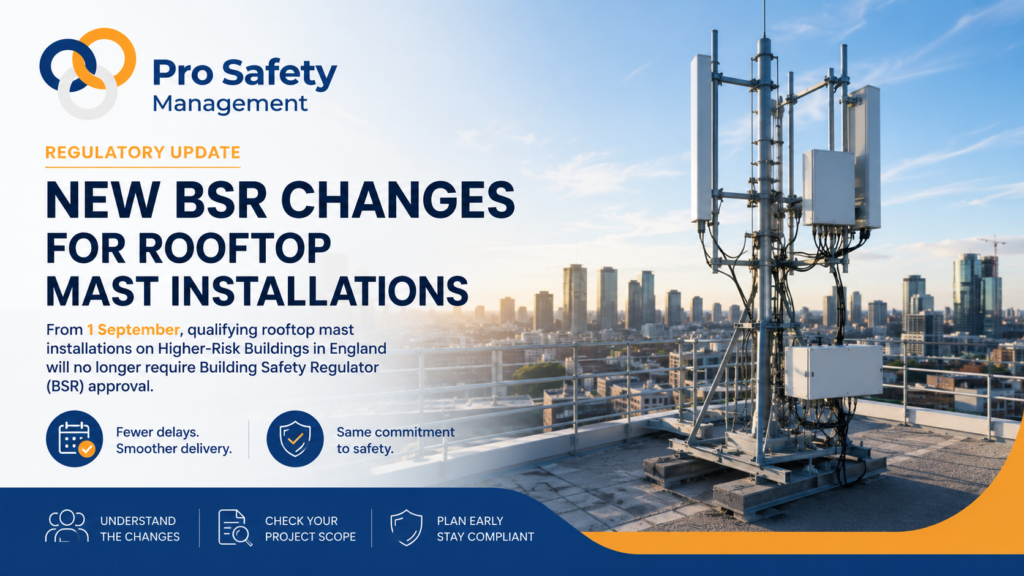
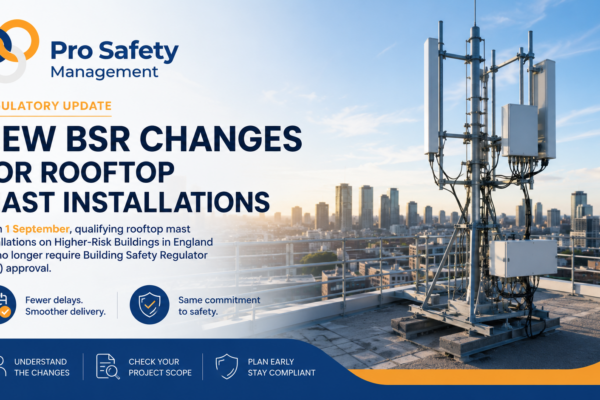
From the 1st September, an important regulatory change will come into effect for the telecommunications industry in England. Certain rooftop mast installations on Higher-Risk Buildings (HRBs) will no longer require approval from the Building Safety Regulator (BSR), marking a significant step towards streamlining deployment while maintaining high safety standards.
For mobile network operators, infrastructure providers, landlords and principal contractors, this change has the potential to reduce delays and simplify project delivery. However, it is equally important to understand where the exemption applies—and where it does not.
At Pro Safety Management, we believe that early planning and informed decision-making remain critical to ensuring projects remain compliant while taking advantage of the new regulatory framework.
What is Changing?
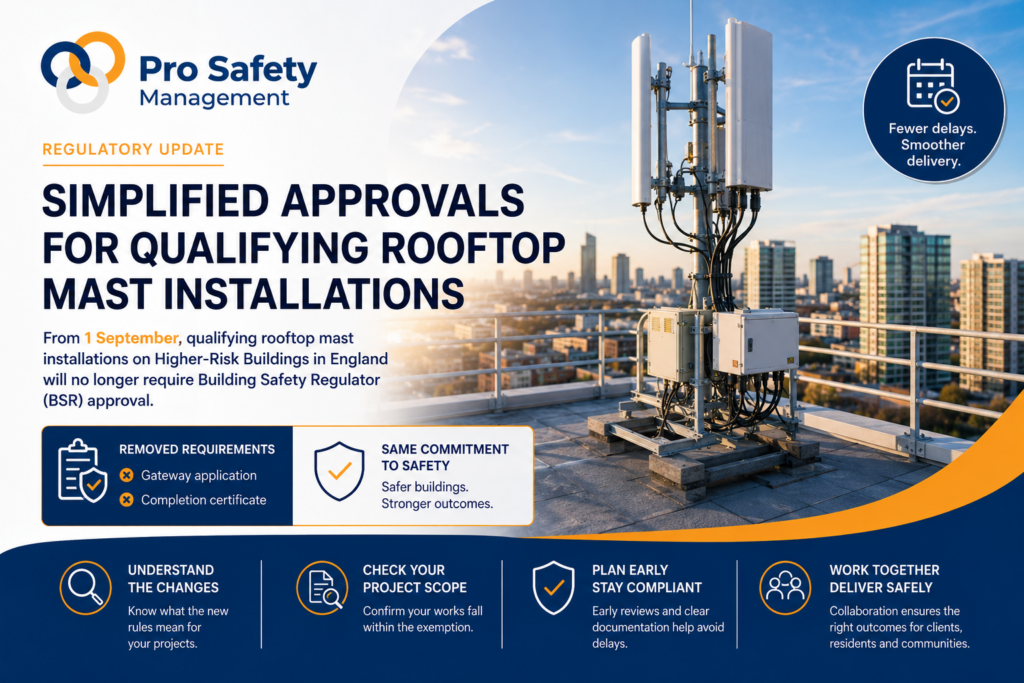
Under the new exemption, rooftop mast installations on Higher-Risk Buildings that consist solely of a rooftop mast and its ancillary connections will no longer require Building Safety Regulator approval.
This means qualifying projects will no longer need to submit:
- A Building Safety Regulator Gateway application
- A Building Safety Regulator completion certificate
Removing these approval stages is expected to reduce programme timescales and minimise administrative burdens for straightforward rooftop telecommunications installations.
For an industry under constant pressure to improve connectivity and expand network coverage, this represents a positive development.
Why This Matters
Since the introduction of the Building Safety Act, additional regulatory oversight has understandably increased the time required to deliver projects on Higher-Risk Buildings.
While these regulations play a vital role in protecting residents and ensuring building safety, the approval process has also created challenges for telecommunications programmes where relatively low-impact rooftop installations have been subject to the same regulatory gateway process.
The new exemption recognises that not every rooftop installation carries the same level of building safety risk.
For qualifying projects, organisations may benefit from:
- Reduced programme delays
- Faster mobilisation
- Improved access to residential rooftop sites
- Lower administrative costs
- Greater certainty during project planning
This is welcome news for the telecommunications sector as demand for improved mobile coverage and digital infrastructure continues to grow.
The Exemption Is Narrowly Defined
Although the announcement is positive, it is important not to assume that every rooftop telecoms project will automatically qualify.
The exemption applies only where works are limited to:
- A rooftop mast
- Ancillary equipment and associated connections
Many projects will still fall outside these criteria.
For example, Building Safety Regulator approval may still be required where works involve:
- Structural strengthening beyond ancillary requirements
- New risers passing through the building
- Installations mounted on external walls rather than the roof
- Other alterations that extend beyond the defined exemption
Every project should therefore be assessed on its individual scope rather than relying on broad assumptions.
Why Early Planning Is More Important Than Ever
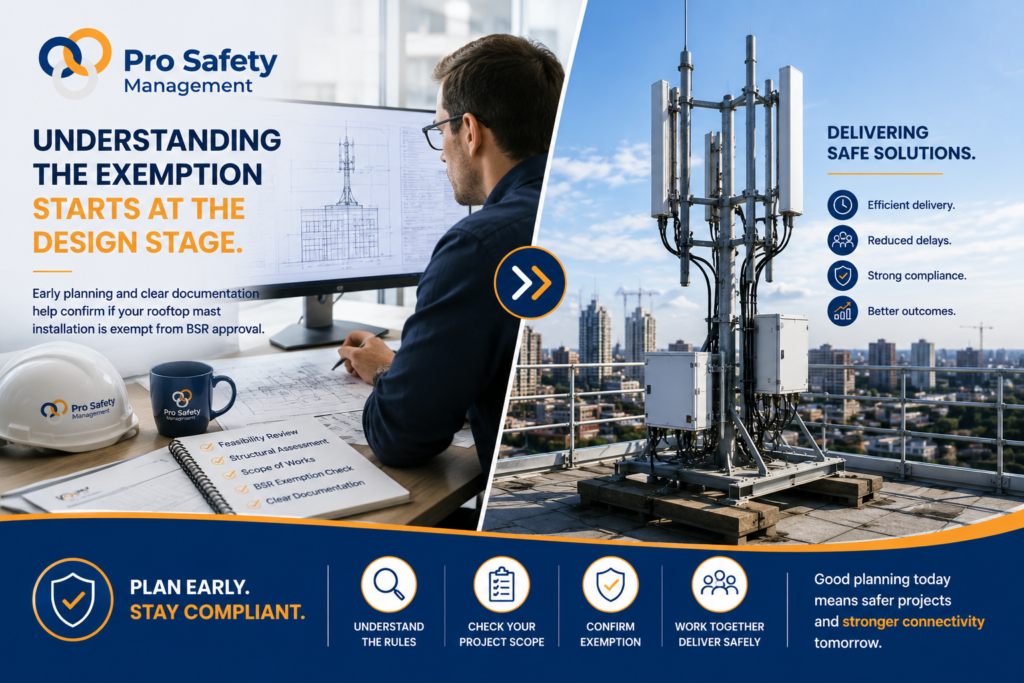
Rather than removing the need for planning and technical review, the new exemption places even greater emphasis on getting the early stages of a project right.
Before work begins, project teams should clearly establish whether the proposed installation genuinely falls within the exempt category.
This requires robust due diligence, including:
Early Feasibility Assessments
A detailed feasibility study helps determine whether the installation can be delivered without triggering additional regulatory requirements.
Structural Reviews
Although the exemption removes the need for BSR approval in qualifying cases, the structural integrity of the building remains paramount.
Independent structural assessments should continue to confirm that the building can safely accommodate the proposed installation.
Clear Scope Definition
One of the most common causes of regulatory issues is scope creep.
What begins as a simple rooftop mast installation can quickly evolve to include additional works that invalidate the exemption.
Clearly defining the project scope at design stage reduces this risk.
Comprehensive Documentation
Maintaining accurate records remains essential.
Drawings, structural calculations, design decisions and justification for applying the exemption should all be properly documented.
Should questions arise later in the project, comprehensive records provide valuable evidence that the correct regulatory route was followed.
Compliance Remains Essential
Although the requirement for Building Safety Regulator approval is being removed for certain installations, the wider obligations under the Building Safety Act remain unchanged.
Dutyholders must still ensure that projects are designed, managed and delivered safely.
Competence, effective coordination, risk management and quality assurance continue to be fundamental throughout the project lifecycle.
Compliance should never be viewed as a hurdle—it is an essential part of delivering safe, sustainable infrastructure.

How Pro Safety Management Can Help
Navigating changes to building safety legislation requires technical expertise and practical experience.
At Pro Safety Management, we work with mobile network operators, infrastructure providers, contractors and property owners to help deliver compliant telecommunications projects across England.
Our services include:
- Building Safety Act consultancy
- Principal Designer support
- Design and compliance reviews
- Structural coordination
- CDM advice
- Regulatory guidance for Higher-Risk Buildings
Whether a project falls within the new exemption or still requires Building Safety Regulator approval, our team can help ensure the correct processes are followed from the outset.
Looking Ahead
The new exemption is a positive development for the telecommunications sector and reflects a more proportionate approach to regulating low-impact rooftop installations.
However, success will depend on correctly identifying which projects qualify and ensuring robust planning, competent design and clear documentation remain at the heart of every scheme.
As the Building Safety regime continues to evolve, organisations that invest in early compliance and expert advice will be best placed to deliver projects efficiently, safely and without unnecessary delays.
If you’re planning telecommunications works on a Higher-Risk Building and would like advice on whether your project qualifies for the new exemption, contact Pro Safety Management today. Our specialists are here to help you navigate the regulations with confidence.
Ready to strengthen Health & Safety within your organisation?
Whether you’re looking to improve leadership, develop your management team, review your existing Health & Safety arrangements or discuss a specific challenge, we’re here to help.